
Weekly Update – July 21st – Mosquitoes on the Decline
July 21, 2026
Weekly Update – August 3rd – Rain, Finally, But Still Few Mosquitoes
August 3, 2026

Mosquito numbers continue to decrease into August, the month when West Nile virus peaks.
Mosquitoes stay below average with a slight decrease last week.
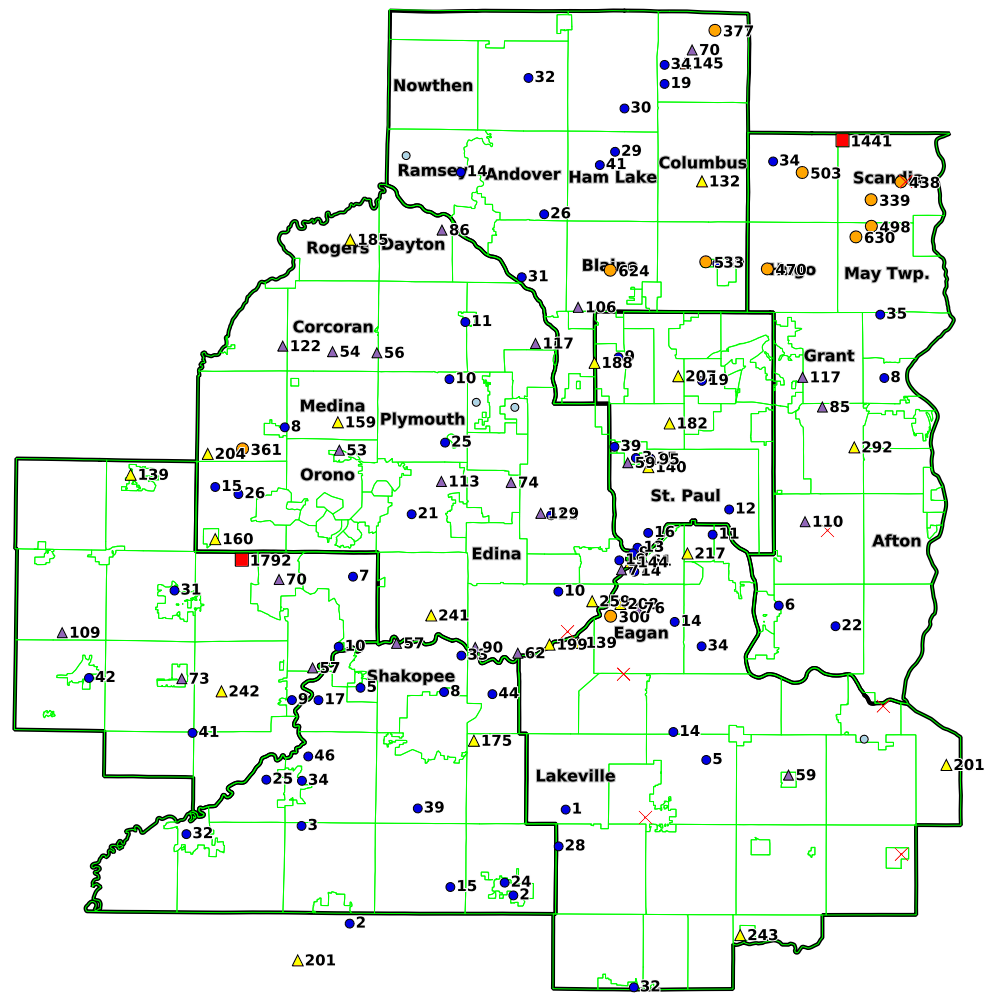
Almost every Carbon Dioxide baited trap set throughout the Twin Cities in our weekly surveillance network caught fewer mosquitoes last week than the week prior. There remains to be a few hot spots with two traps collecting over 1,000 mosquitoes - one on the north border of Washington County and one on the northern border between Carver and Hennepin Counties. Most traps collected fewer than 100 mosquitoes, which is below average for this time of year.
In a typical year mosquitoes decline throughout the month of August and with the lack of rain in the past week, and very little in the 10-day forecast, there is no reason to suspect that this year will be any different.
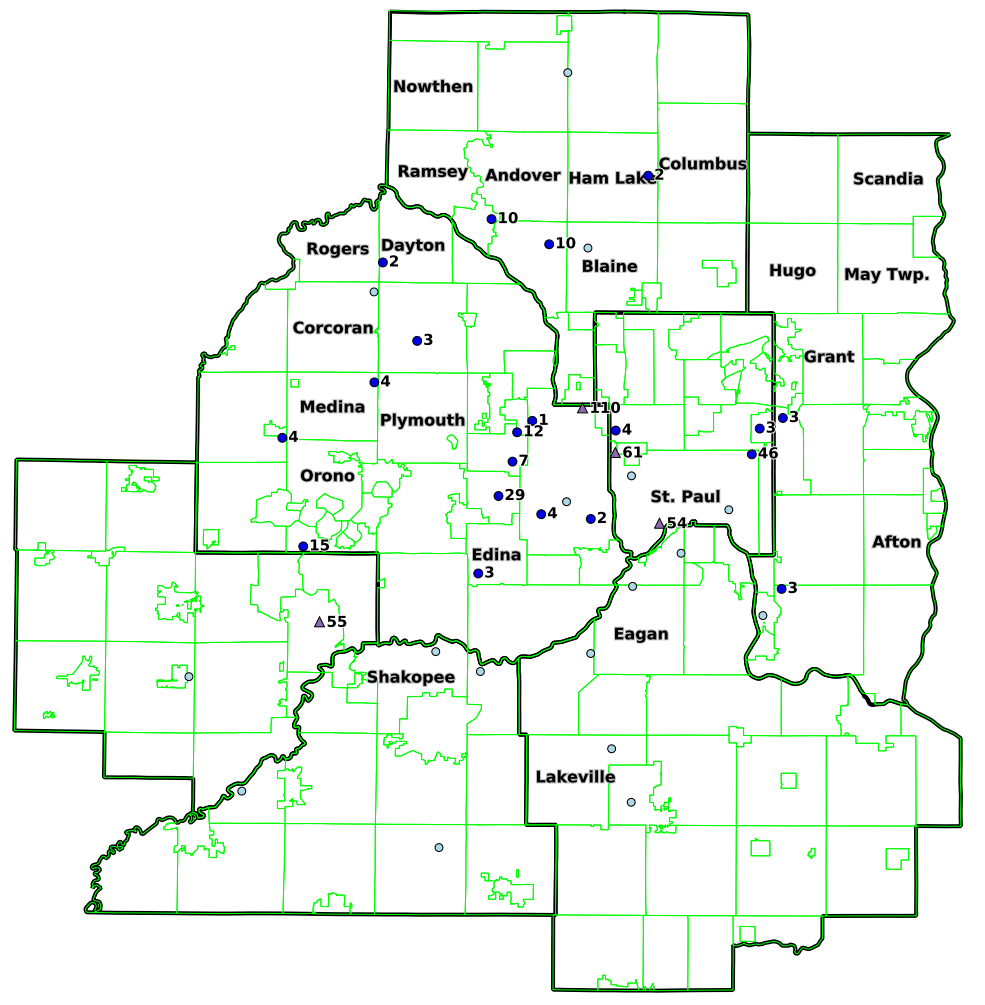
Here are this week's maps:
West Nile Virus Risk is Lower This Year, but August is the Peak Month for Human Transmission of the Disease
As we flip the calendar from July to August, attention turns from primarily nuisance species like cattail mosquitoes to disease vectors like the species primarily responsible for the transmission of West Nile virus. The fight against vector-borne disease takes place all season at MMCD, but the risk of West Nile virus transmission and several other diseases increases in the latter part of the season.
According to MMCD Entomologist, Dr. Scott Larson, "The lack of nuisance mosquitoes isn't an issue, but this is the time of year to worry about West Nile virus. Vectors of WNV actually do pretty well in dry conditions. And human cases of WNV are more prevalent in the later months of the season. Here's a graph from the CDC showing the onset date of human cases in the US:"

Graph provided by the Centers for Disease Control
In last week's sampling there were four new positive pools of mosquitoes that tested positive for West Nile virus: 2 in Ramsey County, 1 in Hennepin County, and 1 in Dakota County. Each of these counties have had positive samples already this season. The pool of mosquitoes in Dakota County consisted of Culex tarsalis mosquitoes, which is significant because this is an opportunist species that is likely to bite humans.
According to MMCD Vector Ecologist, Dr. Jordan Mandli, "Although still a minor contributor, Culex tarsalis made its first appearance in positive pools this season. As a major driver of the 2025 WNV outbreak, Cx. tarsalis has been notably absent from WNV detections thus far. However, its abundance has increased sharply over the past several weeks, potentially elevating its role in transmission as the season progresses."
The overall number of Culex mosquitoes is lower than both the 5- and 10-year average according to the new MMCD Vector Index:

Screenshot from a Beta version of the new Vector Index.
The next few weeks are typically when vector activity peaks, so we will be closely monitoring vector disease activity and positivity rate of mosquito pools that get tested.
Above is a screenshot from the new MMCD Vector Index, which is in the works to highlight several important factors related to disease vector activity in the Twin Cities. The current version of the Vector Index is in testing mode, but we expect a publicly available option to be made available in the future. This project was made possible by MMCD Data Systems Coordinator, Dr. Nancy Read and Field Operations Supervisor Alex Dyakin, with support from the MMCD entomology lab and vector ecologist, Dr. Jordan Mandli.
Survey on Awareness of Mosquito Control Activities
Researchers at the University of Illinois Urbana-Champaign and the Midwest Center of Excellence for Vector-Borne Disease are conducting a study to understand what people in the Midwest know about mosquitoes and the diseases they spread. Your input will help us create better educational materials to keep communities safe.
What’s involved?
Just one online survey that takes about 10-20 minutes. You’ll answer questions about mosquitoes and their control, and any information sources you have on the topic.
Ready to participate? Click the link below:
https://redcap.link/mosquitocontrol
Thank you for your time and for helping us improve public health messaging and mosquito control efforts in your community.
If you have any questions, please contact the study team at mosquitoes@illinois.edu or (217)-300-1428.

Staff from our Maple Grove facility out checking for mosquito larvae.
Upcoming Events
Come out and see staff from the Metropolitan Mosquito Control District at one of these upcoming events:
- Wednesday, July 29th - Sunday, August 2nd - Washington County Fair in Stillwater
- Sunday, August 2nd - Canadian Days Parade in Little Canada
- Tuesday, August 4th - National Night Out Events in St. Francis, Nowthen, and West Lakeland Township
Would you like MMCD to come to your event or speak to your group? E-mail Alex Carlson!
Video of the Week - Mosquito Bite Games - Original Edition
Last week we shared that the Mosquito Bite Games, Habitat Edition won a Northern Lights Award, but did you know that video was a sequel? The original Mosquito Bite Games premiered in 2020 with Buzz and Scratch and a host of other characters. Check it out below!
Win an MMCD T-Shirt!
Here is your chance to win either the new MMCD Attack Larvae T-Shirt or last year's Laser Loon shirt. Sign up for "The Weekly Buzz" newsletter with Weekly Mosquito updates. Each week there will be a trivia question at the end. Two correct answers each week will get a shirt!
Enter your e-mail address below to sign up now!


