

Weekly Update – September 21st – Farewell Mosquitos
September 21, 2026
The lab is slated to open in April of 2027.
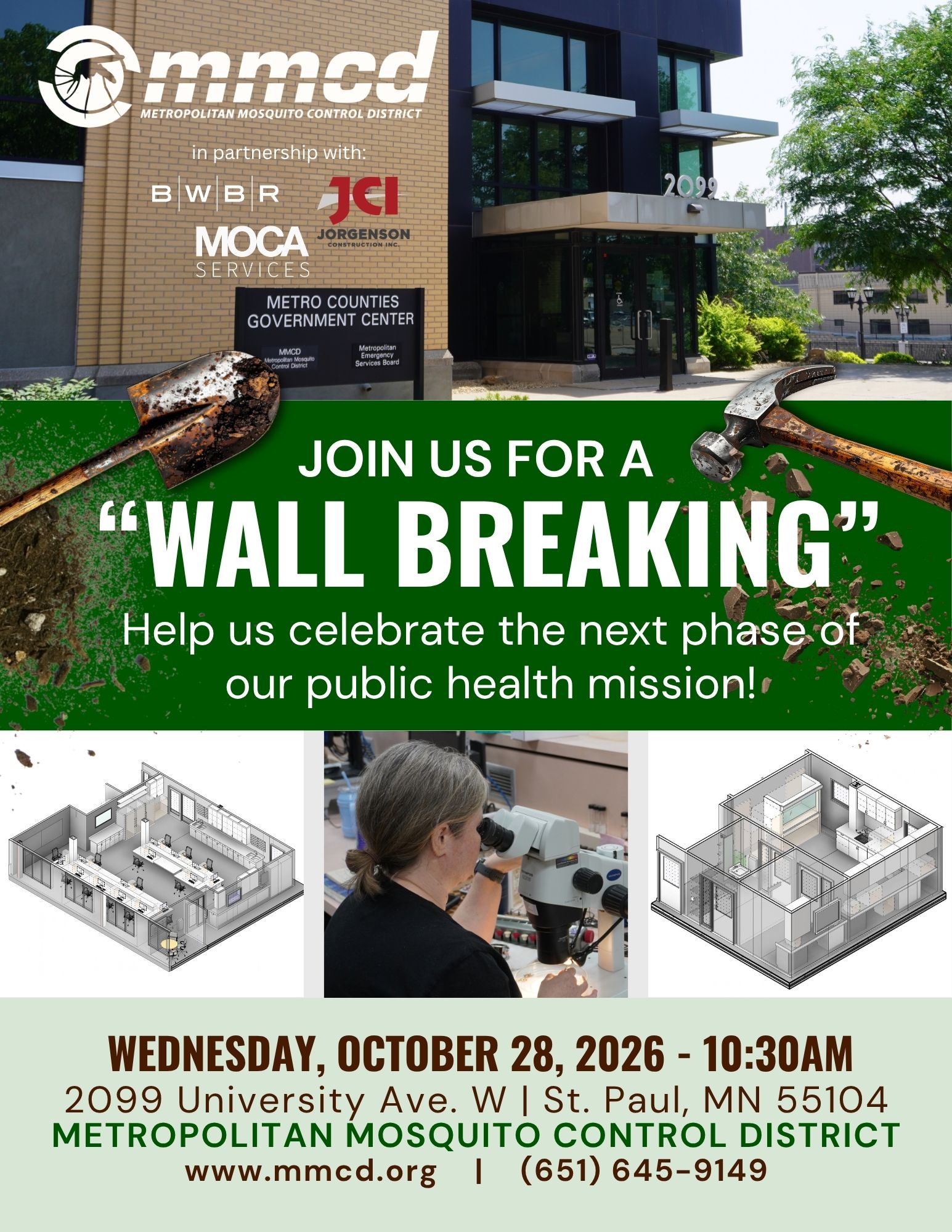 SAINT PAUL – The Metropolitan Mosquito Control District (MMCD) headquarters in St. Paul is about to receive a major upgrade. The 15,000 square foot building on University Avenue was originally constructed in 1991 to house the Entomology Lab and administrative offices and serve as the main hub for mosquito control activities. Now, for the first time in over 35 years, the building is being renovated to allow for upgraded public health technology, expanded capacity for lab staff, and new local government neighbors.
In July, Commissioners on the Metropolitan Mosquito Control District Board accepted the bid of Jorgensen Construction to proceed with a renovation that will change the layout of the St. Paul facility’s lower level. “The project is being funded through MMCD’s capital plan,” says MMCD Business Administrator Maria Mancilla-Diaz. “We appreciate the MMCD Commission’s support and authorization to move the project forward.”
The entomology lab will be redesigned to accommodate more full-time staff and seasonal technicians, and a pathogen detection lab will be added to allow for expanded disease monitoring. “The remodel of the Entomology Taxonomy Laboratory will increase our capacity for the critical function of identifying mosquitoes, black flies, ticks, and other organisms,” says District Entomologist, Dr. Scott Larson. “Two insectaries will be constructed for our scientific staff to rear mosquitoes for identification, maintain colonies of important vector species, and test the efficacy of our control materials.”
Part of that expansion involves increased ability to test for diseases caused by mosquitoes and ticks. “With the addition of the [pathogen detection] laboratory, MMCD will be able to detect a broader range of vector-borne pathogens and remain at the forefront of identifying new and emerging public health threats,” says MMCD Vector Ecologist Dr. Jordan Mandli. Previously, MMCD used a rapid antigen test to detect West Nile virus (WNV) in mosquito samples. An updated pathogen detection laboratory will offer increased capacity and improved accuracy in testing for WNV and additional mosquito-borne diseases like La Crosse encephalitis and Eastern equine encephalitis. With national headlines about tick-borne disease on the rise, there is a goal that the new lab space will allow MMCD scientists to test for Lyme disease and other tick-borne pathogens to better serve residents of the Twin Cities.
Office space will also be added to create six new offices for staff members of the Metropolitan Library Service Agency (MELSA). The upper level of the building houses administrative offices for MMCD and the Metropolitan Emergency Services Board (MESB). The addition of MELSA improves efficiency by housing three county service agencies under one roof - offering cost-savings and opportunities for collaboration.
A “wall-breaking” ceremony will be held to kick-off construction and recognize the MMCD Commission’s support for the expanded public health laboratory. MMCD will host the wall-breaking in partnership with Jorgensen Construction, BWBR Commercial Design, and Moca Services on Wednesday, October 28th at 10:30AM (following the MMCD Full Commission meeting) at 2099 University Ave. W, St. Paul, MN 55104.
###
For press inquiries or interview requests, please contact Alex Carlson - acarlson@mmcd.org or (651) 643-8342.


