

Weekly Update – August 12th – Mosquitoes Right on Target with the 10-Year Average
August 15, 2025
Weekly Update – August 26th – The End of Mosquito Season is Approaching!
September 3, 2025
Mosquito numbers continue to decline this week, in line with the 10-year average.
The mosquito season continues to wind down and thankfully this week that includes several disease vector species.
Every Monday night starting in mid-May through September, the Metropolitan Mosquito Control District sets out a variety of mosquito and black fly traps throughout the district and employs a network of sweep net collections done by employees and volunteers. Any insects collected are brought back to our lab on Tuesday to be identified throughout the week with maps published to show current mosquito and black fly activity.
Suddenly it feels like fall in Minnesota with cooler temperatures and a decline in the mosquito population. Last week's traps collected the lowest number of human-biting mosquitoes since the first week in June and cooler overnight temperatures means they were probably not very active this past weekend. Last week brought great conditions for mosquitoes, however, and despite our best efforts we might see a slight uptick in the population this coming week. According to MMCD Entomologist, Dr. Scott Larson, "Unfortunately, because the rain we received last weekend over a number of days resulted in a series of hatching events there were a lot of varied ages of mosquitoes in the larval airwork samples. Therefore, I'm predicting we will see a slight increase in adult mosquitoes next week." Looking at the 10-year average graph, it's typical for the last week in August to bring one last gasp of mosquitoes, but we won't know for sure how much until later this week.
Many areas are not likely to see much of a surge, however, thanks to the hard work of MMCD staff. Last week field and lab staff worked extra long hours to respond to the brood that resulted from the heavy rains over the weekend. Altogether, MMCD treated over 35,000 acres by helicopter last week alone which was one of the biggest weeks we've seen all summer. This will likely go far in reducing a major spike in adult mosquito activity as those mosquitoes would have been emerging from the water early this week or over the last few days.
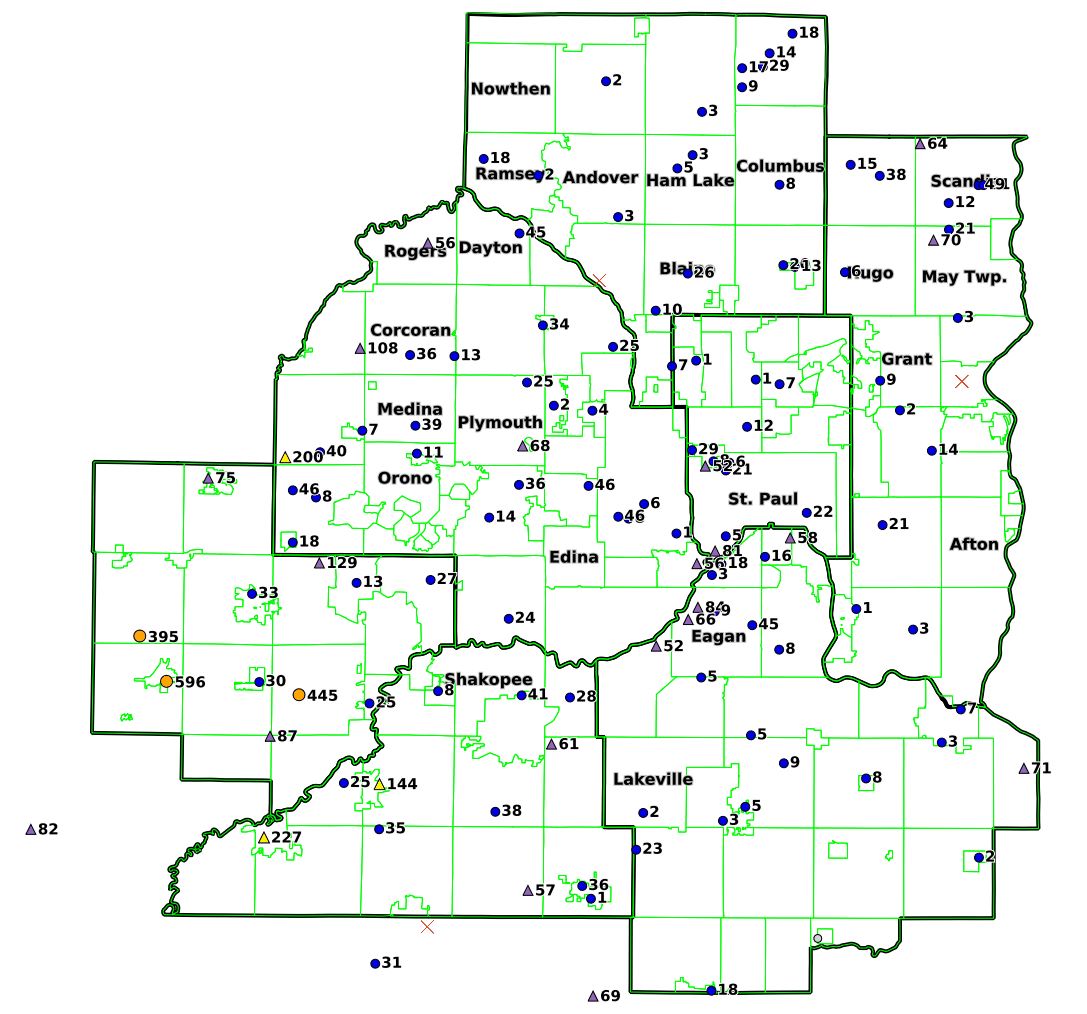
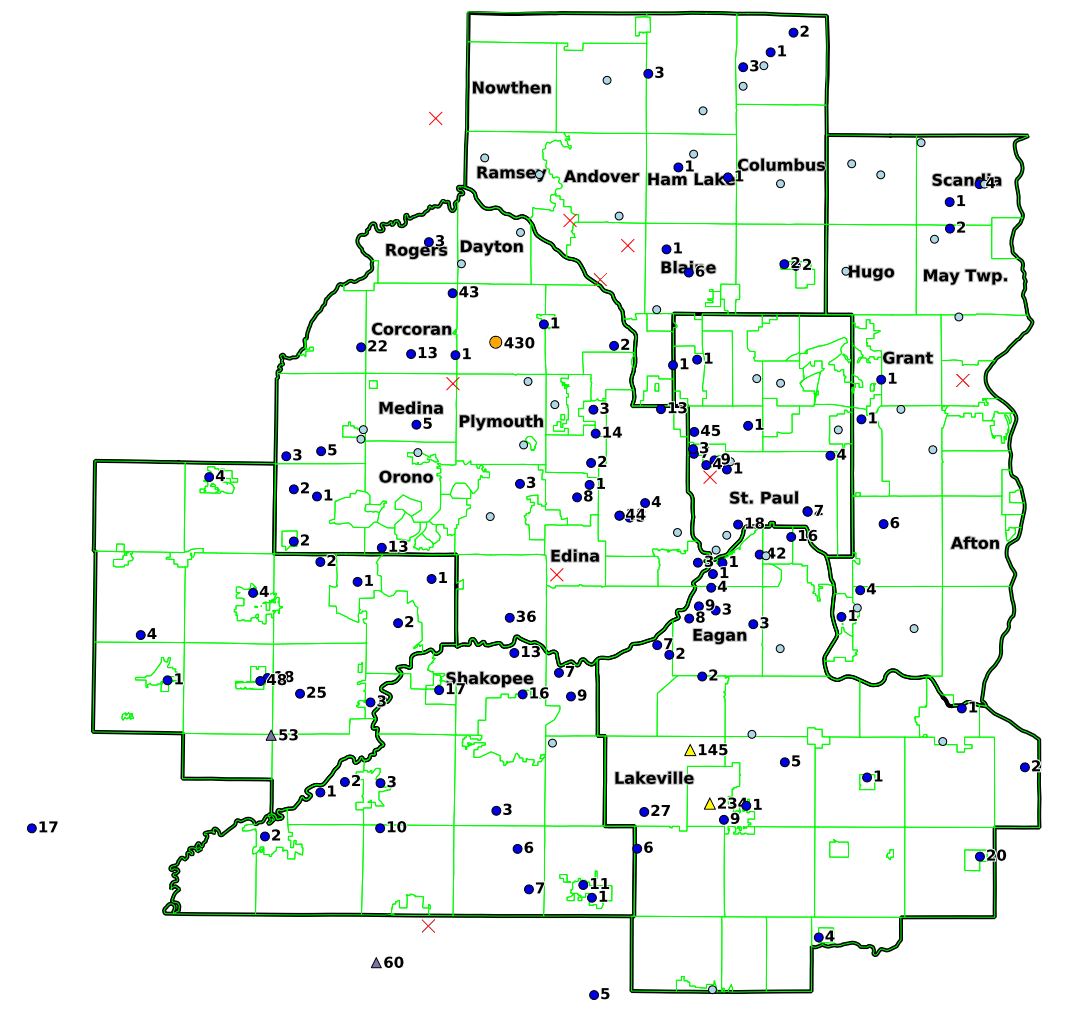
Below are maps showing all human-biting mosquitoes (left) and Culex mosquitoes (right) collected in CO2 and Gravid traps on August 11th-12th:
West Nile virus activity continues to decline throughout the District.
While nuisance mosquitoes (like the summer floodwater mosquito or the cattail mosquito) have been on the decline for weeks, the bigger concern has been the higher than normal activity of West Nile virus vectors (like Culex tarsalis) combined with some of the highest infection rates we'd seen. Thankfully, those too appear to be on the decline. According to MMCD Vector Ecologist, Dr. Jordan Mandli, "District-wide, the Minimum Infection Rate (MIR) decreased from 15.3 to 10.3, based on 23 positive pools out of 153 total. Infected pools shifted further away from Cx. tarsalis (MIR = 5.4) and now strongly favor Cx. pipiens (11.5)."
There is always lag time from when mosquitoes are collected that carry the disease to when human cases are reported, but according to Dr. Mandli, "Currently, [the Minnesota Department of Health] has recorded six cases of WNV among district residents with one resulting in death and another in hospitalization. The location of transmission for the single fatality likely originated outside the bounds of the district. Additional cases are still under review."
We will continue to share alerts about West Nile virus activity as it develops, but for the moment the risk is declining, but not zero so please continue to wear that bug spray and keep yourself safe!
Teachers: Request a FREE Interactive Classroom Presentation!
It's time for back to school and MMCD has many great offerings for students of all ages. Throughout the school year mosquito control staff visit over 40 schools and offer interactive presentations that feature specimens, microscopes, educational tools, and lots of hands-on learning.
There are a few different types of presentations available:
- In-Classroom Presentation – Uses PowerPoint slides, videos, and trivia to teach students about insects.
- Stations-Based Experience – We will set up several learning stations with vials of ticks and mosquitoes, microscopes, mosquito control traps and other equipment, and (depending on the season) some live aquatic larvae. Students will move to each station in groups of 10 or fewer.
- Outdoor Presentation – Go outside near a mosquito habitat and do some hands-on exploration. Students will learn dipping techniques, how to identify different insect habitats, and more.
- Hybrid – Combine one or more of the above to create a custom experience!
Presentations are ideal for 3rd – 12th grade and the content will be adjusted based on ages and teacher suggestions for curriculum focus. Our schedule fills up quickly in the Spring and Fall, so contact us today!
Check out our video promo for classroom presentations below:


